Science and the Shelter Dog: How Do We Improve Adoption?

Animal shelterHow to improve adoption of shelter dogs based on the current scientific findings: Which dog training and behavior modification programs work best.

Speaker: Alexandra (Sasha) Protopopova, MS, CPDT-KA

Alexandra (Sasha) Protopopova, MS, CPDT-KA, will discuss the various training and behavior modifications programs currently in use and how to improve adoption of shelter dogs. Using scientific findings, she will identify  which of these programs work best to improve the adoption of shelter dogs. With the numerous amounts of training and behavior modification programs out there designed to improve shelter dog adoptions, how do we know which ones to implement at our shelter that will actually improve the rates of successful adoption at a shelter? In this webinar, you will learn what research and science can tell us about adoption. Science has asked questions such as: How do people choose dogs? What do adopters prefer dogs to look and act like at the shelter? What about breed-specific training programs at a shelter?

Learn about past scientific studies that have assessed training programs at shelters as well as our on-going research at the University of Florida on adopter preferences, assessment of current training protocols, as well as our plans for future research that will finally develop a validated, efficient, and effective training program to improve welfare and adoption success of shelter dogs.

Discussion will follow, moderated by Dr. Monique Udell.

Live online:   July 17, 2013

Time: 8:00-9:30 PM EDT (Midnight GMT)

Available OnDemand (Recorded) after the lecture.

CEU’s Available:
2 IAABC CEU’s
2 CCPDT CEU’s (1 CBCC)

Pairing Pavlovian Conditioning with Operant Odor-Discrimination Training

dogsniffSpeaker: Nathaniel Hall, M.S.

Recorded Live online- March 20, 2013

NOW Available OnDemand (Recorded) upon purchase.

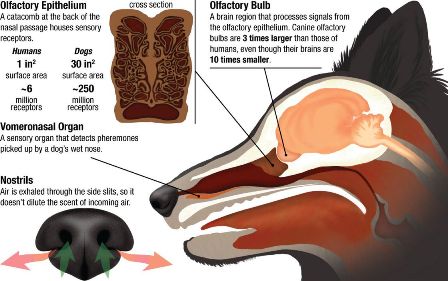
In this talk, I will present ongoing research our lab is conducting on the canine sense of smell. I will describe the procedures we have developed to quickly train an odor-discrimination in dogs, and how we have used this procedure to evaluate the effects of procedural manipulations on odor-detection in dogs. I will then present data from ongoing research that evaluates the effect of how familiar a target odor is, on the acquisition of an odor discrimination. I will show that more familiar odors are more readily learned; however, how the odors were ‘familiarized’ is important.  The effect of familiarity in our sample was the result of Pavlovian conditioning and not mere exposure to the odor. Throughout the talk, I will review basic concepts of olfaction, Pavlovian conditioning, and how Pavlovian conditioning and operant conditioning interact. I will conclude by indicating how the present research might be useful for the training of working odor-detecting dogs.

2 IAABC CEU’s
2 CCPDT CEU’s (CBCC or CPDT)

Cost: $25.00

Where to get scent and nose work supplies?
www.k9nwsource.com  New and exclusive items. Everything from Odor to Containers and more.
K9NW-Source-Logo-Paw-Print-in-O-e1358433740240


Dingoes, the ‘missing link’ between wolves and domestic dogs?

Speaker: Dr. Bradley Smith

Description:  The dingo, a wild living canid endemic to Australia is one of the world’s most controversial animals, and remains a source of significant contradiction. It is considered both a native animal and an invasive pest; a tourist draw card and a dangerous threat; devastating to the agricultural industry yet crucial for a healthy ecosystem; a baby killer and a beloved companion. Some suggest that dingoes are an example of a ‘proto’ dog- one of the earliest living forms of the domestic dog, but the dingoes past remains enigmatic. This presentation explores the fascinating and little known story of the dingo. With the dingo-human relationship as a central theme, it 

traces the intriguing journey of the dingo from its possible beginnings as a semi domesticated wild dog in Asia, to its current status as a wild animal under threat of extinction. During this time, the dingo has demonstrated an unparalleled intelligence and adaptable nature seen in few species. In this 

presentation, I will attempt to define what a dingo is, how it relates to other members of the Canid family in terms of genetics, physiology, cognition and behaviour. As one of the few remaining wild dogs left in the world, I argue how dingoes offer valuable insight into the domestication of wolves and the traditional human–canid relationship.le as a recording after the lecture.

Recorded Live:  February 6, 2013  

Available now OnDemand (Recorded)

2 IAABC CEU’s
2 CCPDT CEU’s (CBCC or CPDT)

Cost: $25.00

Measuring Behavior and Temperament in Dogs: New Methods and Applications

Speaker: Dr. James Serpell

Description:  Studies suggest that behavior problems are one of the most important reasons why people abuse, abandon, disown or euthanize companion dogs. Improved knowledge of the distribution and causes of behavior problems in the pet dog population could therefore contribute greatly to the welfare of dogs worldwide. Unfortunately, because most dogs live inside people’s homes, they are difficult and sometimes impossible to observe for the extended periods of time needed to properly evaluate their behavior or temperament. It is therefore necessary to develop different kinds of measurement techniques for this purpose. The Canine Behavioral Assessment & Research Questionnaire (C-BARQ; http://www.cbarq.org) is one such technique that relies on measurement by proxy. Instead of observing and measuring the animal’s behavior directly, the C-BARQ collects indirect behavioral information provided by the dog’s owner, guardian or handler. This presentation will outline how and why the C-BARQ was originally developed and validated, and will describe some of the intriguing ways it is currently being used to improve our understanding of canine behavior and behavior problems.

Recorded Live:   December 5, 2012

Available now OnDemand (Recorded)

CEUs
2 IAABC CEU’s
2 CCPDT CEU’s (CBCC or CPDT)

Cost: $25.00


FREE BOOK GIVEAWAY! Simply registering for this webinar enters you in the contest:


Animal Health and Wellness Series

2012-2013 LIVE Schedule

Past Lectures-Lecture Library

Many incredible lectures recorded Live for you to view OnDemand (Recorded). All have CEU’s available. Go HERE for the list of Lectures.

Moderator – Sheilagh O’Sullivan

Live Lectures will be held on the second Tuesday of each month from 7:30-9:00 PM EST

Live Online-7:30-9:00 PM EST; 10:30 PM GMT

June 11, 2013
Is Your Pet Stressed?
Speaker:
Dr. Ava Frick, DVM
Yes, animals get stressed too.  In addition to the obvious environmental events and circumstances, there are some underlying reasons why this can happen to one and not another.  I will share with you what happens in the body to set your pet up to develop anxiety and behavior related disorders and what you can do to prevent and change the outcome.  The focus of this presentation will be the energy wave patterns of the brain and how those can be improved using microcurrent therapy, vitamins, minerals, and heavy metals that affect the personality and how those deficiencies or toxicities can be diagnosed and corrected.
Cost: $25.00


July 9, 2013
The Dog Owners Holistic Toolkit for Optimal Behavior, Training and Performance
Speaker: Kathy Kawalec
How our dogs FEEL has a profound influence on how they learn, behave and perform. Your dogs’ physical, mental and emotional parts all need to be in balance for optimal learning and happy living. Any person who shares their life with a dog can learn my simple tools for bringing balance and harmony into their dogs’ life…making training easier and performance better. This lecture will cover:

  • The Mind-Body Connection – how it all comes together into a Whole Dog perspective.
  • The Importance of Your Dogs Physical Condition and Conditioning.
  • The Effect Your Dog’s Emotions have on their Behavior, Training and Performance.
  • Simple and Effective Holistic Tools that anyone can use to help their dog.

Mental and Emotional Conditioning for You – help your dog by being the best YOU can be.


August 12, 2013
Tell Your Dog What To Do Without Talking
Speaker: Jo Maldonado, Owner and Founder-Center for Animal Therapies/C.A.T.
Scientific studies have shown that dogs “read” what we are saying by observing our body language, sound of our voice, facial expressions, and even our thoughts. This phenomenon of animal communication happens not just consciously but from a subconscious level. When we don’t realize what messages we are sending to our dogs, we end up with “misbehavior” issues. This presentation covers the foundation principles in sending correct messages.

September 10, 2013
Are Toy Dogs Different or are We Just Making Excuses For Them?
Speaker: Shana Carranco
Are tiny dogs born with bad behavior such as yappy, barking, arm pit monsters?  Are they hard to potty train? Or do we as humans teach them & treat them differently than their larger counter parts.  In this seminar we will explore both parts of the question in search for the answer.


October 8, 2013

November 12, 2013

December 10, 2013


Ethology and Canine Behavior Lecture Library A-Z

Ethology and Canine Behavior Lectures-alphabetically. All recorded Live. To learn more about each, please click on the lecture titles.

Aggressive Behavior With Dogs ~ Solutions and Strategies
Speaker: Ken McCort 

Price: $25.00

Animal Personality: What do we know and where shall we go?
Speaker: Sam Gosling, Ph.D.  

Price: $25.00

Behavior Adjustment Training For Reactive Dogs
Speaker: Grisha Stewart
 

Price: $25.00

Canine Cognition
Speaker: Clive Wynne, Ph.D.
 

Price: $25.00

Connections: The Evolution & Natural History of the Dog and the Human / Dog Relationship.
Speaker Monty Sloan  

Price: $25.00

Deep in Thought or Panting Mindlessly? A Scientific Investigation of Anthropomorphism.
Speaker: Julie Hecht, MSc  

Price: $25.00

Developing Self-Control in Dogs with Behavioral Issues
Speaker: Dee Ganley 

Price: $25.00

Development of Behavior in Dogs (Canis lupus familiaris) and Wolves (Canis lupus lupus)  Speaker: Kathryn Lord, Ph.D.  

Price: $25.00

Differentiating Between Fearful and Submissive Behavior in Canines
Speaker: Monty Sloan 

Price: $25.00

Dog Play “Gone Bad”
Speaker-Sue Alexander 

Price: $25.00

Dominance Behavior in Wolves and Dogs
Speaker: Monty Sloan
 

Price: $25.00

Emotions as Learned Behavior
Speaker-Kellie Snider, MS
  

Price: $25.00

Speaker: Barbara Handelman, M.Ed., CDBC   
Price: $25.00

Enriching the Lives of Canines through Human Interaction: Research Evaluations and Practical Applications
Speaker: Lindsay R. Mehrkam, M.S.  

Price: $25.00

Ethology and Its Place in Animal Science
Speaker-Erich Klinghammer, Ph.D
  

Price: $25.00

Keeping Dogs Safe During Dog to Dog Encounters
Speaker: Barbara Handelman, M.Ed, CDBC 

Price: $25.00

Learning Styles of Dogs
Speaker: Rachel Friedman, MSW, LISW 

Price: $25.00

Of Wolves and Dogs: From The Big Bang to the Chihauhau
Speaker: Charlie Berger, DVM 

Price: $25.00

Research in Dog Training: Current Projects and Future Directions
Speaker: Nicole Dorey, Ph.D.  

Price: $25.00

Speaker: Clive Wynne, Ph.D. 
Price: $25.00

Temperament Assessment for Function or Friend
Speaker: Nina Bondarenko
 

Price: $25.00

Terriers: From Yorkies to Pit Bulls, What Makes Them Different?
Speaker: Ken McCort 

Price: $25.00

Too Dog-Tired to Behave: Self-Control in Canines is Sensitive to Fatigue
Speaker: Holly Miller, Ph.D.
 

Price: $25.00

LECTURE SERIES

Purpose: The lecture series aims to introduce participants to a variety of topics and points of view within the canine industry in an online meeting environment.

Series General Information: The lecture series has a number of different specialty areas. Each specialty area is moderated by a leader in the field and lectures are provided by luminaries who have spent a lifetime studying, working in and writing about their chosen specialty. A detailed list of the different lecture series on offer can be found below. Click on each series link to access detailed information on topics, presenters and moderators.

Prerequisites: None

Course Length: Each series offers a 90 minute lecture once a month. The series are ongoing with no defined start or end date. Specific dates and times for each series can be found by clicking on the individual series’ link below.

Course Format: All lectures are only available in the Live Online format. Participants may register for a single lecture or for a block of lectures. 3, 6 or 12 month blocks are available. For individuals unable to participate in the Live lecture due to time differences and personal schedules we recommend that you purchase a lecture of interest from The Library. Scroll to the bottom of the page for details on this purchase option.

LIVE online lectures: This format of each monthly session will be a ninety-minute question and answer session with a moderator and a single guest lecturer. Participants, through their home computers, will have access to a multi-media, on-line, virtual classroom, in which they may view text, photo, and video slides in PowerPoint format and simultaneously taking part in live Q & A session, via a telephone connection. These 90 minute sessions are jam-packed with information. Each program will be recorded live, and participants may revisit the program in its recorded form up to three times within the month following its original presentation date. Participants will receive handouts, and suggested readings prior to the evening’s event, and may prepare and submit questions, in writing, for the experts, that may be answered live, as time permits.

Series Specialties:

Ethology and Canine Behaviour Series

Health and Wellness Series (Coming in Summer 2012)

Breeding and Genetics (Coming in Fall 2012)

The Library: Each lecture is recorded and is available for purchase as an OnDemand session. Lectures are added to the Library for purchase 60 days after the Live lecture has been completed. The on-demand purchase of each lecture may be accessed three times within a month of the purchase date. Participants will receive a link to the recorded lecture, the suggested readings list and the CEU credit. Participants will NOT receive any handouts or course materials nor will they be able to ask questions of the lecturer. To see a list of available lectures in the library and to register click HERE.

Course Fees -

For Credit Live and OnDemand: A single lecture: $25.00

To Register simply go to the series you are interested in and click on the “ADD TO CART” button on the series page.

Student Information:

Download Flash Player for free. 98% of computers worldwide already have Flash.You must also read and agree to the E-Training for Dogs, Inc. Standard Terms and Conditions prior to taking a course: Click HERE to read these. You will be asked when you register if you have read them and will not be allowed to take the course if you do not agree to the terms.

ETHOLOGY AND CANINE BEHAVIOUR SERIES

Past Lectures-Lecture Library

Over 2 dozen incredible lectures recorded Live for you to view OnDemand. All have CEU’s available. Go HERE for the list of Lectures.

2012-2013 LIVE Schedule

Moderator – Monique Udell, Ph.D.

Live Lectures will be held on the first Wednesday (USUALLY…please check each lecture) of each month from 8:00-9:30 p.m. Eastern time

NEXT LECTURE
Live Online-8:00-9:00 PM EDT (Midnight GMT)

June 5, 2013
Speaker: Beth Duman, CPDT-KA
Your Dog is a Wolf, but it’s Not!! ….a Day without Pee is a Day without Sunshine! 

Wolf behavior – how it relates to training dogs is the question at the core of understanding where dogs came from and how they developed from a wild animal to our household pet. We all know through recent genetic analysis that our dog’s ancestors were wolves. How do we use this information to better work with and understand our canine companions? Biologist and trainer, Beth Duman, CPDT-KA, VSPDT will guide you through a lively discussion of wolf behavior and ecology and how this relates to our training methods and interactions with our pet dogs. Cost: $25.00


July 17, 2013
Science and the Shelter Dog: How Do We Improve Adoption?
Speaker: Alexandra (Sasha) Protopopova, MS, CPDT-KA
With the numerous amounts of training and behavior modification programs out there designed to improve shelter dog adoptions, how do we know which ones to implement at our shelter? Discover what science can tell us. How do people choose dogs? What do adopters prefer dogs to look and act like at the shelter? What about breed-specific training programs? Learn about past scientific studies that have assessed training programs at shelters as well as learn more about our on-going research at the University of Florida on adopter preferences, assessment of current training protocols, as well as our plans for future research that will finally develop a validated, efficient, and effective training program to improve welfare and adoption success of shelter dogs.

August 7, 2013 -
(TBA: From Argentina- studies social behavior and learning in foxes, wolves, and dogs)
Speaker: Dr. Mariana Bentosela, Ph.D.

September 4, 2013
Dog Cognition: A Report from Kyoto
Speaker: Dr. Kazuo Fujita
In this talk, Dr. Fujita will present studies on various cognitive functions in dogs conducted as an activity of CAMP-WAN, Companion Animal Mind Project – Wide Area Network, Kyoto University (see https://sites.google.com/site/kyotocampwan2/home — Japanese website). Topics include: episodic use of incidentally formed memory, multimodal recognition of owners and genders, understanding of social characteristics of humans, inference of physical environment from social information, and behavioral characteristics related to genetic variations. We find wonderful intelligence and behavioral flexibility of dogs in many of the tests but at the same time limitations of their cognitive abilities.

October 2, 2013
Talk Title: TBA
Speaker:  Trish McMillan Loehr MSc, CPDT-KA

Please go to: The Library for a detailed list of available lectures, fees and important information regarding registration and access to this wonderful resource. Each lecture is recorded and is available for purchase as an OnDemand session. Lectures are added to the Library for purchase 60 days after the Live lecture has been completed. The on-demand purchase of each lecture may be accessed three times within a month of the purchase date. Participants will receive a link to the recorded lecture, the suggested readings list and the CEU credit. Participants will NOT receive any handouts or course materials nor will they be able to ask questions of the lecturer.

THE LIBRARY-Ethology and Canine Behavior


Cost per OnDemand recorded lecture session: $25.00 USD Students have 30 days unlimited access within the month following purchase.  Check back often. A new lecture is added every month.

The following is a list of recorded lectures from the Lecture Series available for purchase as OnDemand sessions. The lectures are listed by date recorded live. Click on each link to learn more about each lecture.

For an alphabetical list, click HERE.

ALL lectures have CCPDT and IAABC CEU’s available. Please check under EACH for the number and status.

Ethology and Its Place in Animal Science
Speaker-Erich Klinghammer, Ph.D
(Recorded October, 2010) Description:  This lecture establishes an understanding of ethology, the history of the field and the contributions ethologists have made to the understanding of the behavior of canines and other species.
CEU’s: CCPDT=1.5 CBCC-KA and CPDT-KA; IAABC1.5 CEU’s
Price: $25.00


Emotions as Learned Behavior
Speaker-Kellie Snider, MS
(Recorded November, 2010) Description:  This lecture will help improve the ability of participants to accurately observe dogs in real world situations, to understand how emotions play a role in learning, and how emotions themselves can be learned behaviors.
CEU’s: CCPDT=1.5 CBCC-KA and CPDT-KA; IAABC1.5 CEU’s
Price: $25.00


Dog Play “Gone Bad”
Speaker-Sue Alexander (Recorded December, 2010) Description:  The emphasis in this lecture is on the nature of canine play and how to assess behavioral cues in order to prevent play escalating into a dangerous fight. Students learn how to recognize behavioral cues that t indicate that play is escalating and might evolve into a dangerous fight.
CEU’s: CCPDT=1.5 CPDT-KA; IAABC1.5 CEU’s
Price: $25.00


Of Wolves and Dogs: From The Big Bang to the Chihauhau
Speaker: Charlie Berger, DVM (Recorded January, 2011) Description:  Dr Berger discusses the evolution of dogs, their relationship to wolves, and the association of dogs with humans from pre-historic times to the present. Participants will have increased knowledge of the origin of all canids, how they began their association with humans, and how humans have influenced the evolution of dogs in general, and dog breeds specifically, in recent times.
CEU’s: CCPDT=1.5 CBCC-KA and CPDT-KA; IAABC1.5 CEU’s
Price: $25.00


Canine Cognition
Speaker: Clive Wynne, Ph.D.
(Recorded February 3, 2011) Description:  Dr. Wynne  discusses the historical and current studies of canine cognition, including studies comparing the abilities of dogs and wolves.  Also addressed are questions related to how anthropomorphism effects human interpretation of canine ability and whether or not canines have a “theory of mind.”
CEU’s: CCPDT=1.5 CBCC-KA and CPDT-KA; IAABC1.5 CEU’s
Price: $25.00


Dominance Behavior in Wolves and Dogs
Speaker: Monty Sloan
(Recorded March 3, 2011) Description:  Monty Sloan discusses “Dominance Theory” and how it applies differently to dogs and wolves.  Also addressed is the relevance of “dominance” in captive and wild wolf packs, and in groups of dogs, including the differences between dominance and leadership.
CEU’s: CCPDT=1.5  CPDT-KA; IAABC1.5 CEU’s
Price: $25.00


Differentiating Between Fearful and Submissive Behavior in Canines
Speaker: Monty Sloan
(Recorded April 7, 2011) Description: Monty Sloan presents information about the comparative definitions of fear and submission. Photo illustrations allow participants to learn to differentiate between the body language signals of these differing emotional states in wolves and dogs.
CEU’s: CCPDT=1.5  CPDT-KA; IAABC1.5 CEU’s
Price: $25.00


Aggressive Behavior With Dogs ~ Solutions and Strategies
Speaker: Ken McCort (Recorded May 5, 2011) Description: Ken McCort presents information about the comparative definitions of types of canine aggression, as well as strategies and solutions for working with aggressive dogs.  He uses photo illustrations allowing participants to learn to differentiate between the body language signals of these differing types of aggression.
CEU’s: CCPDT=1.5  CPDT-KA; IAABC1.5 CEU’s
Price: $25.00

Temperament Assessment for Function or Friend
Speaker: Nina Bondarenko
(Recorded June 2, 2011) Description: Students will gain an understanding of temperament testing and assessments such as: what is assessed; who assesses; does assessment work; what tests are available; dog personality assessments for Assistance Dogs; what personality traits make a good Assistance Dog; example of an assessment; and how to test puppies for canine working careers and for pet homes.
CEU’s: CCPDT=1.5 CBCC-KA and CPDT-KA; IAABC1.5 CEU’s
Price: $25.00


Behavior Adjustment Training For Reactive Dogs
Speaker: Grisha Stewart
(Recorded July 2011) Description: BAT is method to reduce reactivity by giving dogs socially acceptable ways to communicate their needs. This lecture will provide the student with a solid understanding of the history and science behind the BAT method and knowledge of the application of BAT (“how to”).
CEU’s: CCPDT=1.5 CPDT-KA; IAABC 2.0 CEU’s
Price: $25.00


Developing Self-Control in Dogs with Behavioral Issues
Speaker: Dee Ganley
(Recorded: August 4 2011) Description: Dee Ganley, author of “Changing People, Changing Dogs” covers several practical methods of teaching dogs to achieve self control. This 90 minute lecture is jam-packed with information and video demonstrations that will have you and your dog, or your clients and their dogs, on their way to a happy and satisfying relationship.
CEU’s: CCPDT=1.0 CBCC-KA and 2.0 CPDT-KA; IAABC1.5 CEU’s
Price: $25.00


Learning Styles of Dogs
Speaker: Rachel Friedman, MSW, LISW
(Recorded September 1 2011) Description: Many know about the different learning styles of people. In this lecture, learn about the Learning Styles of Dogs. Then how to use that knowledge in providing practical and reality based applications in dog training  –  regardless of age, breed or gender.
CEU’s: CCPDT=1.5 CPDT-KA; IAABC1.5 CEU’s
Price: $25.00


Keeping Dogs Safe During Dog to Dog Encounters
Speaker: Barbara Handelman, M.Ed, CDBC, Certified Behavior Consultant
(Recorded October 6 2011) Description: In this lecture the following subjects are discussed in-depth, with accompanying illustrations in the form of photographs and videotapes of dogs interacting: Distance increasing signals; Distance decreasing signals; Play invitation behaviors; Metasignals (how the dogs know it really is still play); and, Indicators of stress: ranging from mild to extreme.
CEU’s: CCPDT=0.5 CBCC-KA and 1.5 CPDT-KA; IAABC1.5 CEU’s
Price: $25.00


Too Dog-Tired to Behave: Self-Control in Canines is Sensitive to Fatigue
Speaker: Holly Miller, Ph.D.
(Recorded November 3, 2011) Description: Research with humans and dogs suggests that executive control relies on a limited resource and that invoking executive control depletes this resource. Once depleted, subsequent efforts to control behavior are impaired and greater impulsivity, memory impairment, and aggression are observed. Research suggests that these deficits associated with depletion can be eliminated if subjects consume a glucose (but not a calorie-free) drink.studies self-control in humans and dogs. As a graduate student at the University of Kentucky, Holly helped develop the Canine Cognition Lab and Science Dog Daycare at the University of Kentucky.
CEU’s: CCPDT=1.0 CBCC-KA and 2.0 CPDT-KA; IAABC 2.0 CEU’s
Price: $25.00


The Development of Behavior in Dogs (Canis lupus familiaris) and Wolves (Canis lupus lupus)
Speaker: Kathryn Lord, Ph.D. (Recorded December 1, 2011) Description:
While many dog trainers use similarities between dogs and wolves to inform their training and handling techniques, it is their differences that teach us the most. This talk will be focused on my research investigating early behavioral differences between dogs and wolves, and how these differences effect later adult behavior and training.
CEU’s: CCPDT=2.0 CBCC-KA and 2.0 CPDT-KA; IAABC 2.0 CEU’s
Price: $25.00


Research in Dog Training: Current Projects and Future Directions
Speaker: Nicole Dorey, Ph.D. (Recorded January 5, 2012) Description: With so many different training methods available to dog trainers, research in dog training is very important. This lecture will discuss some of the research that has been conducted to date and that is currently being conducting by Dr. Nicole Dorey. The hope is that this information will inspire dog trainers to think critically about the methods that they use and to investigate which is the best method for optimal learning.
CEU’s: CCPDT=1.0 CBCC-KA and 2.0 CPDT-KA; IAABC 2.0 CEU’s
Price: $25.00


Terriers: From Yorkies to Pit Bulls, What Makes Them Different?
Speaker: Ken McCort
(Recorded February 2, 2012) This presentation will look at the behavior of terriers and the motor patterns that make them behave differently than other breeds.  Although there is sometimes a genetic predisposition to behave like their ancestors, there are many things we trainers can do to get them to function as household pets.  This presentation will examine the history, behavior and training of this group of dogs.
CEU’s: CCPDT=1.0 CBCC-KA and 2.0 CPDT-KA; IAABC 2.0 CEU’s
Price: $25.00
 

Deep in Thought or Panting Mindlessly? A Scientific Investigation of Anthropomorphism.
Speaker: Julie Hecht, 
MSc Lab Manager, Horowitz Dog Cognition Lab @ Barnard College (Recorded March 1, 2012)
Anthropomorphism is the attribution of human characteristics to objects, events or nonhuman animals. It is often framed as the misattribution of human qualities to that which is not human. How do we consider an animal’s point of view while guarding against inappropriate use of anthropomorphism? And what does inappropriate anthropomorphism even look like? This presentation pulls from various disciplines to explore: how and why we anthropomorphize, physical and behavioral prompts of anthropomorphisms and exciting new research investigating notable anthropomorphisms.
CEU’s: CCPDT=1.0 CBCC-KA and 2.0 CPDT-KA; IAABC 2.0 CEU’s
Price: $25.00

Speaker: Clive Wynne, Ph.D., Professor of Psychology, University of Florida, Gainesville, and Director of Research at Wolf Park at Battle Ground, Indiana. (Recorded live April 5, 2012)
Did dogs arise as dumpster divers, or hounds helping with the hunt? In recent years I have been traveling the world trying to find the answer to this most basic question about our canine companions. I shall report on the tame foxes of Siberia, the dingoes of Australia, stray dogs on several continents, as well as gray wolves in Indiana, and offer my tentative conclusions about the dog’s mysterious origins.
CEU’s: CCPDT=2.0 CBCC-KA and 2.0 CPDT-KA; IAABC 2.0 CEU’s
Price: $25.00 


Connections:
 The Evolution & Natural History of the Dog a
nd the Human / Dog Relationship.
Speaker Monty Sloan  (Recorded live May 3, 2012) Where did dogs come from? What is their connection with wolves, with humans? Monty Sloan explored the deep connection that humans and dogs share, including a discussion of the evolution and natural history of the human/dog relationship. Topics included the possible origins of dogs, early behavioral ecology and canine form, domestication versus socialization or taming, and examples of natural and artificial selection that may have resulted in the diversity of dog types and breeds we see today.
CEU’s: CCPDT=2.0 CBCC-KA and 2.0 CPDT-KA; IAABC 2.0 CEU’s
Price: $25.00


Speaker:  Dr. Alliston K. Reid, Wofford College  (Recorded live June 7, 2012)
Dr. Alliston Reid describes the story behind the exciting research that demonstrates that dogs, like children, can learn that certain words represent individual objects, and other words represent categories of objects, independent in meaning of what they are asked to do with those objects. Newspapers, magazine articles, and radio & television programs describing their research have appeared in over 46 languages and on every continent. Dr. Reid will talk about the publicity, as well as the rigorous science underlying the story, which was published in Behavioural Processes.
CEU’s: CCPDT=2.0 CBCC-KA and 2.0 CPDT-KA; IAABC 2.0 CEU’s
Price: $25.00
Speaker: Lindsay R. Mehrkam, M.S.  (Recorded live July 12, 2012)
Any dog owner will tell you that they play an essential role their dog’s lives, but what are the actual behavioral effects we have on our canines? In this lecture, we will discuss both empirical research findings and the practical utility of how human interaction  – our touch, our voices, and even just our attention – can bring out a wide range of behaviors in not only dogs, but also wolves, wolf-dog hybrids, and coyotes that demonstrate the positive – and sometimes negative side effects -  of our close relationship with canines.
CEU’s: CCPDT=1.0 CBCC-KA and 2.0 CPDT-KA; IAABC 2.0 CEU’s
Price: $25.00
Speaker: Barbara Handelman, M.Ed., CDBC  (Recorded live August 9, 2012)
This presentation is relevant to all horses who spent significant periods of time confined in a stall.  This includes horses who are stabled all the time unless being worked; horses who come in from their pastures for the night; and horses who are confined because of sickness or injury. In this presentation, illustrated with MANY still photos and video of horses, Handelman will offer examples of stressed animals, animals in pain, and animals exhibiting stereotypic and other compulsive behaviors. It is essential that owners, trainers, and behavior consultants be able to recognize both subtle and overt signs of stress, and be able to differentiate signs of stress from physical pain and aggressive arousal.
While this presentation is based on Handelman’s current work with horses restricted to stall rest, parallels exist in the confinement and rehabilitation of all animal species.
CEU’s: CCPDT= 1.5 CPDT-KA; IAABC 1.0 CEU’s
Cost: $25.00
Speaker: Sam Gosling, Ph.D.  (Recorded live September 6, 2012)
In the late 1990s, the idea of non-human animals having personality was treated with skepticism or even ridicule by the scientific community. But now, little more than a decade later, the topic is a well-established, vibrant area of research in such fields as behavioral ecology and applied ethology. Consistent individual differences in personality have been identified in numerous non-human species, ranging from octopuses and guppies to hyenas and chimpanzees. What brought about animal personality’s change in fortunes? And what promise does it hold for Anthrozoology and allied fields? This talk will summarize the major discoveries from the field, focusing on the challenges the field has faced and those that lie ahead. For example, questions about measurement have long dogged the field, with concerns focusing on three basic issues: (1) that personality cannot be measured reliably in animals, (2) that the assessments are overly subjective, (3) that the methods required to obtain valid assessments are impractical. Using data from our studies of on spotted hyenas, dogs, chimpanzees, squid, and humans I address each concern and evaluate the viability of personality assessments in animals. Next, I shall discuss some major challenges that lie ahead. These include addressing concerns regarding anthropomorphism, determining the best level at which to conceptualize personality, the need to develop a common taxonomy for describing personality, the importance of construct validation, and integrating the ideas of variation within individuals and across the lifespan. Finally, I shall consider the implications of this work in science (e.g., understanding the genetic bases of personality) and applied settings (e.g., identifying dogs well suited to explosive-detection work).
CEU’s: CCPDT=2.0 CBCC-KA and 2.0 CPDT-KA; IAABC 2.0 CEU’s
Price: $25.00


Intentional Thinking in Animals: Can They Do It and Is It Necessary

Speaker:
Ken McCort (Recorded Live October 3, 2012)
In this presentation, Ken McCort will explore the subject of Intentional Thinking in animals. Intentional thinking will be defined, exploring what it means in terms of behavior, as well as the levels involved in the process. We will then discuss how intentional thinking may lead to the ability of companion animals, especially dogs, to plot, plan, deceive and trick humans. This subject was first explored in the 1700′s and has been more recently revisited by philosopher Daniel Dennett Ph. D. in the late 1980′s. This cognitive process is very important to understand by anybody involved in handling and training animals of all species.
2 CCPDT CEU’s (1 CBCC); 2 IAABC CEU’s
Price: $25.00


Exploring Taboos
Speaker: Julie Hecht, MSc (Recorded Live, November 7, 2012)
Most dogs live in our homes as four-legged family members, but sometimes their behavior can be a jarring reminder that they are not humans, but canids with their own unique behavioral and sensory systems. In this colorful presentation, Julie Hecht, MSc presents scientific research into some of dogs’ seemingly taboo behaviors, such as humping and crotch-sniffing. This presentation highlights the importance of assessing behavior from the dog’€™s perspective, as opposed to through the lens of human social norms and standards.
2 CCPDT CEU’s (1 CBCC); 2 IAABC CEU’s
Cost $25.00


Measuring Behavior and Temperament in Dogs: New Methods and Applications
Speaker: Dr. James Serpell, (Recorded Live, December 5, 2012)
Studies suggest that behavior problems are one of the most important reasons why people abuse, abandon, disown or euthanize companion dogs. Improved knowledge of the distribution and causes of behavior problems in the pet dog population could therefore contribute greatly to the welfare of dogs worldwide. Unfortunately, because most dogs live inside people’s homes, they are difficult and sometimes impossible to observe for the extended periods of time needed to properly evaluate their behavior or temperament. It is therefore necessary to develop different kinds of measurement techniques for this purpose. The Canine Behavioral Assessment & Research Questionnaire (C-BARQ; http://www.cbarq.org) is one such technique that relies on measurement by proxy. Instead of observing and measuring the animal’s behavior directly, the C-BARQ collects indirect behavioral information provided by the dog’s owner, guardian or handler. This presentation will outline how and why the C-BARQ was originally developed and validated, and will describe some of the intriguing ways it is currently being used to improve our understanding of canine behavior and behavior problems.
2 CCPDT CEU’s (1 CBCC); 2 IAABC CEU’s
Cost $25.00


Practical Ethology: Breeding Selection and Training Choices
Speaker -  Chris Redenbach, CABC, CBCC-KA (Recorded Live: January 16, 2013)
So how does a trainer or behaviorist use “ethology” in their work with dogs? This 90 minute presentation highlights how one breeder/trainer used classical ethological principles to aid in breeding selection for working traits as well as how she uses classical ethology in analyzing behavior and training issues and problem solving. Why does one dog go forward while another runs away? Why does one stock dog use body slams and upper body contact while another goes for the legs? Why did a dog suddenly start attacking long bodied, short legged dogs but not small long legged dogs? Why was the presenter upset when Europe banned ear cropping even though she didn’t like to crop ears? How does ethology apply to teaching the “stay” exercise? The discussion will be an informal introduction to how classical ethology pervades all we do with dogs.
2 CCPDT CEU’s (1 CBCC); 2 IAABC CEU’s
Cost $25.00

 Dr. Bradley Smith  (Recorded Live: February 6, 2013)
The dingo, a wild living canid endemic to Australia is one of the world’s most controversial animals, and remains a source of significant contradiction. It is considered both a native animal and an invasive pest; a tourist draw card and a dangerous threat; devastating to the agricultural industry yet crucial for a healthy ecosystem; a baby killer and a beloved companion. Some suggest that dingoes are an example of a ‘proto’ dog- one of the earliest living forms of the domestic dog, but the dingoes past remains enigmatic.
2 CCPDT CEU’s (1 CBCC); 2 IAABC CEU’s
Cost $25.00


Pairing Pavlovian Conditioning with Operant Odor-Discrimination Training
Speaker:  
Nathaniel Hall, M.S. (Recorded live: March 20, 2013)
In this talk, ongoing research on the canine sense of smell will be presented. Nathan Hall, M.S., will describe the procedures he has developed to quickly train an odor-discrimination in dogs, and how this procedure can be used to evaluate the effects of procedural manipulations on odor-detection in dogs. He will then present data evaluating the effect of familiarity of a target odor on the acquisition of odor discrimination. More familiar odors appear to be more readily learned; however, how the odors are “€˜familiarized”€™ is important. Throughout the talk, Nathan will review basic concepts of olfaction, Pavlovian conditioning, and how Pavlovian conditioning and operant conditioning interact. He will conclude by indicating how the present research might be useful for the training of working odor-detecting dogs.
2 CCPDT CEU’s (1 CBCC); 2 IAABC CEU’s
Cost: $25.00

The Ethology of Play and What Canines Can Teach Us
Speaker: Dr. Karen Davis (Recorded live: April 3, 2013)
Play behavior has often been ignored by many biological researchers due to the difficulty in defining what play is, its function, mechanisms, and origin. Many functional hypotheses of play have been advanced but little supporting evidence is available. Most current theories of play come from social play fighting in rodents or social signaling in primates but canines may turn out to be a critical group for understanding play. Dog play behavior is most often observed in non-stressed healthy animals in the wild or captivity. In most mammals the frequency of play behavior decreases as individuals reach adulthood. During this lecture we will investigate how to define play from an ethological perspective so it can be recognized across taxa. Moreover, the different types of play will be defined. Then, we will discuss some of the hypotheses of the function of play and as well as how canines are a timely and useful group for integrating empirical approaches to the study of play behavior. Finally, we will explore some of my current canine developmental play research and its implications for dog trainers and pet owners.
2 CCPDT CEU’s (1 CBCC); 2 IAABC CEU’s
Cost: $25.00


May 1, 2013
Working with Aggressive Dog Cases
Speaker: Trish King, CDBC, CPDT-KA
Aggression in any form is a serious behavior problem, in some cases a wide variety of people and dogs, both inside and outside the home. As we know, not all people are capable of handling aggressive animals, and there is some aggression which cannot be effectively – and safely – modified. In this presentation, we will discuss various methods of addressing the issue, as well as assessing owners’ capabilities of successful behavior modification.
2 CCPDT CEU’s (1 CBCC); 2 IAABC CEU’s

Cost: $25.00


BAck to Top